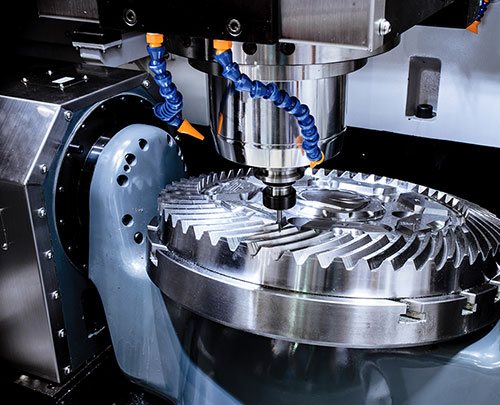


CNC milling is a machining process that utilizes computerized controls to manage the movement and operation of multi-point rotary cutting tools. As the tools rotate and move across the surface of the workpiece, they slowly remove excess material to achieve the desired shape and size.
The CNC milling process can be broken up into four distinct stages:
- CAD model design: engineers create a 2D or 3D design of the desired part
- CAD model conversion to a CNC program: the design is exported into a compatible file format and converted into machine instructions using CAM software
- CNC milling machine setup: the machine operator prepares the machine and workpiece
- Milling operation execution: the machine operator initiates the machining program
The systems used in CNC milling operations are known as CNC milling machines. They can have a moving workpiece and a stationary rotary tool, a stationary workpiece and a moving rotary tool, or a moving workpiece and rotary tool, depending on their design and the milling requirements. As CNC milling generally serves as a secondary or finishing process for machined components, milling machines can be used to create design elements such as flat surfaces, contours, grooves, slots, notches, holes, and pockets.
CNC milling accommodates a variety of materials, including metals, plastics, ceramics, and other engineered materials, making it easy for manufacturers to choose a material that suits their exact needs. This material flexibility benefits a number of industries, including, but not limited to, the following:
- Aerospace and aircraft
- Automotive
- Commercial
- Electronics
- Industrial and OEM
- Maintenance
- Medical
- Technology and security
- Telecommunications
- Transportation